
Case Study
Lot-to-lot consistency and Host Cell Protein impurity profiling of an adenovirus-encoded vaccine using LC-MS

This page has been reviewed and verified by Ejvind Mortz, PhD in Protein Chemistry & Molecular Biology
This page has been reviewed and verified by Ejvind Mortz, PhD in Protein Chemistry & Molecular Biology
Evaluating the lot-to-lot consistency and Host Cell Protein profile of an adenovirus-encoded viral protein vaccine manufactured in a PER.C6 cell line.
The development of vaccines commonly involves multiple scale-ups and transfers to several manufacturing facilities. To ensure product consistency, it is therefore essential to use a robust analytical assay to demonstrate comparability between vaccine lots produced at different scales and sites.
Using the Alphalyse LC-MS method – developed in 2017 and applied in over 700 projects to date1 – we detected and quantified individual Host Cell proteins (HCPs) across several production lots of a viral vaccine.2 This method, using intact protein spike-in standards and now referenced in the US Pharmacopeia General Chapter <1132.1>3,4, is a highly reliable alternative to traditional assays, providing advantages in terms of both regulatory readiness and data-driven process development.
The analytical challenges of vaccines
Like many vaccine types, adenovirus-based products present significant analytical challenges. Modern vaccine formulations are increasingly complex, containing proteins from multiple sources and organisms, including the viral vector itself, as well as manufacturing components and residual chemicals. Substances such as PEG, glycerol, lipids, glutaraldehyde, and high levels of albumin can interfere with conventional analytical methods. In addition, variations in upstream and downstream processes introduce further complexity and increase the risk of Host Cell Protein (HCP) variability.
Traditional methods like SDS-PAGE and ELISA often fall short when analyzing complex vaccine products. SDS-PAGE cannot quantify HCP levels, while ELISA struggles to handle vaccine complexity, lacks the flexibility to accommodate process changes, provides no insight into individual HCP species, and cannot identify specific problematic HCPs that may impact product safety or efficacy.
HCP profile by LC-MS
Biopharmaceutical companies developing complex products will need to measure HCP levels, evaluate batch-to-batch consistency, identify potential HCPs of concern, and characterize the viral protein content of their vaccine for process optimization and regulatory submissions.
In our analysis of two vaccine lots, the LC-MS results demonstrated that the final drug substance was exceptionally pure, with HCP levels measured in the low nanogram-per-milliliter range. The method detected a total of 28 HCPs were detected, all below the lower limit of quantification (LLOQ).
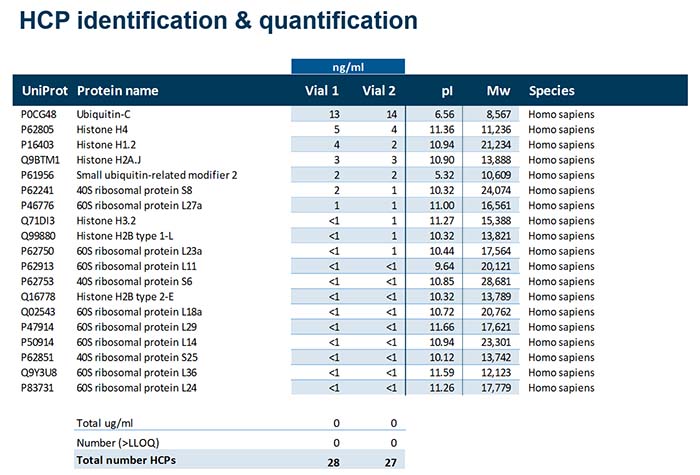
List of the 19 most abundant Host Cell Proteins in the vaccine product. The protein amount is in ng/mL.
Importantly, LC-MS not only measures the total HCP level but also provides the exact identity of each protein present. The resulting list enables risk assessment to determine whether any of them could pose safety or efficacy concerns.
In this case, none of the identified HCPs were known to be problematic, based on Alphalyse's extensive experience with similar biologics.5
The proteins shared some common properties:
Small size – All had a molecular weight below 30 kDa.
Basic isoelectric point (pI) – Most were highly basic, which may explain why they persisted through purification.
This depth of information provides a development team with strong confidence in the safety profile of their product and provides valuable insight for process optimization — for instance, to further improve clearance of small, basic HCPs if needed.
Quantifying viral proteins along with HCPs
The LC-MS assay also enabled quantification of adenovirus proteins in the two samples. By analyzing the distribution and relative abundance of the viral capsid proteins, we could confirm that their ratios matched the well-established stoichiometry of adenoviral particles.
Using these quantified protein levels, it was possible to calculate the number of viral particles present in the product and per dose. The calculated particle counts closely matched the label claim, demonstrating the high accuracy and reliability of the quantification method.
This approach not only confirms the presence of the intended viral content but also enables comparisons of viral protein ratios across batches — a crucial tool for monitoring manufacturing consistency and detecting any deviations that may impact product quality.
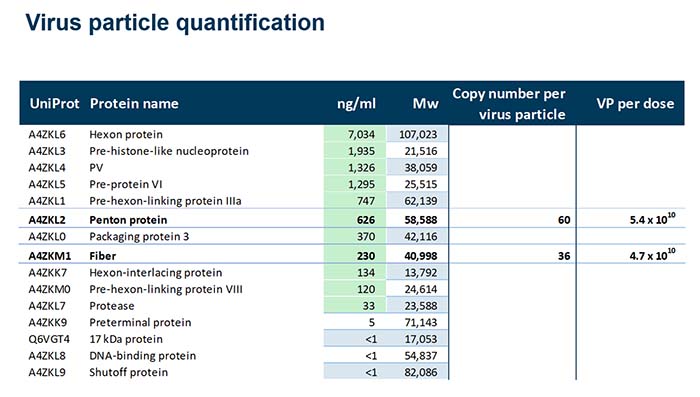
Adenovirus quantification of the top 15 most abundant proteins, listed in ng/mL.
Benefits of LC-MS for HCP analysis
LC-MS–based vaccine protein analysis offers a powerful and flexible solution for characterizing complex biologics. By delivering detailed identification and quantification of host cell proteins, viral proteins, and other process-related impurities, this approach:
Works across platforms – Applicable to a wide range of vaccine types and cell lines.
Enables comparability – Allows direct comparison of protein profiles between batches, scales, and manufacturing sites.
Supports process development – Provides reproducible data for monitoring scale-up and CMO technology transfer.
Meets regulatory needs – Can be validated under GMP and used for release testing when no ELISA or other dedicated assay is available.
For vaccine developers, LC-MS not only confirms product purity and lot consistency but also offers additional insights, such as viral particle quantification without the need to develop or set up an additional assay.
Implementing an LC-MS approach supports faster and more confident process decisions, helping to accelerate time to market.
>> Find out more about our vaccine analysis services >>
On demand webinar
Better vaccine purity and consistency –
Best practice HCP analysis by LC-MS
In just 30 minutes, you get practical insights on:
- 2025 updates from regulatory authorities and vaccine experts
- Best practices described in USP <1132.1> on HCP analysis by LC-MS
- Real-world case studies from clients developing complex vaccines
References
[1] Pilely et al. Monitoring process-related impurities in biologics–host cell protein analysis. Analytical and Bioanalytical Chemistry, 2022.
[2] First presented by Ejvind Mørtz at the Biopharmaceutical Emerging Best Practices Association (BEBPA) 2022 Host Cell Protein Conference.
[3] United States Pharmacopeia. USP General Chapter <1132.1> — Residual Host Cell Protein Measurement in Biopharmaceuticals by Liquid Chromatography-Mass Spectrometry. 2025
[4] Chrone et al. Host cell protein quantitation by LC-MS. Experimental demonstration, qualification, and comparison of methods in USP 1132.1. Journal of Pharmaceutical and Biomedical Analysis, 2025.
[5] Coye et al. Host Cell Protein Clinical Safety Risk Assessment — An Updated Industry Review. Biotechnology and Bioengineering, 2025.
Talk to us
Whatever protein-related challenge or question you may have, we would love to help. Our experts can help you decide on the best analytical approach for your project by email or online meeting - providing advice without obligation.