
News
BEBPA 2026 HCP Conference Highlights: Insights from Alphalyse
July 1, 2026 – By Victor Chrone, Ejvind Mørtz, and Cecilie Hovitz Lautrup-Larsen.
Key takeaways from BEBPA 2026
Conference: Biopharmaceutical Emerging Best Practices Association Host Cell Protein Conference
Date: May 27-29, 2026
Location: Boulder, Colorado
Focus: Host Cell Protein (HCP) analysis, USP <1132.1>, ELISA and LC-MS workflows
Main themes at BEBPA 2026:
- If BEBPA 2025 established LC-MS as a central pillar of HCP analysis, BEBPA 2026 focused on operationalizing it in practice. The discussion has moved from whether mass spectrometry should be used to where it best fits across characterization, process development, QC, and release testing.
- US Pharmacopeia General Chapter <1132.1>, official since May 1, 2025, has become the industry’s shared reference point for LC-MS-based HCP analysis. There was broad consensus that USP <1132> on HCP-ELISA should be expanded to formally include LC-MS.
- PLBL2, the first high-risk HCP described in the literature, was revisited as a test case for a more mature view of impurity risk, based on accumulated industry and regulatory experience.
- Emerging modalities, including gene therapy, AAV vectors, vaccines, and non-mammalian expression systems, continue to challenge the monoclonal-antibody-centric framework underlying current HCP guidance.
- A new, field-wide concern surfaced: the volatility of protein reference databases, which threatens the long-term traceability and comparability of MS-based HCP data.
Below is our summary of the most important topics, trends, and takeaways from the 2026 BEBPA conference, and what it means for the work we do together with our clients.
About the 2026 BEBPA HCP Conference
Every year, BEBPA brings together the people who are shaping how the biopharmaceutical industry handles host cell protein impurities. Regulators, industry scientists, technology developers, and academics meet in this non-commercial forum to collectively advance the understanding of HCP analytics, best practices, and regulatory expectations.
This year’s conference, held on May 27-29 in Boulder, Colorado, was the 14th edition.
Victor Chrone, our Director of Informatics & Digital Solutions, attended in person. He presented a poster on Alphalyse’s in-silico pipeline for evaluating LC-MS-based HCP assay coverage and joined the closing panel on protein reference database stability, a topic that was one of the most interesting and industry-relevant discussions of the conference.
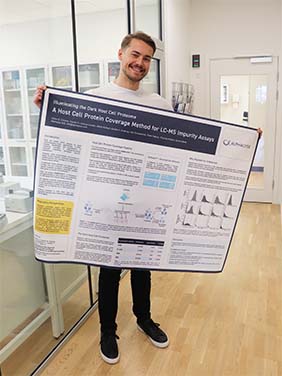
Victor Chrone with his poster for the 2026 BEBPA conference
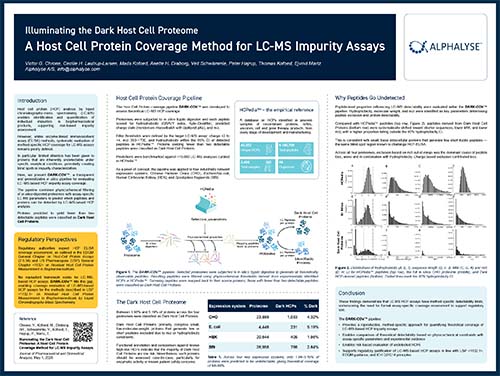
Poster based on peer-reviewed, open access article Illuminating the Dark Host Cell Proteome: A host cell protein coverage method for LC-MS impurity assays
BEBPA is associated with the BEBPA Host Cell Protein conference, a specialist meeting focused on host cell protein analytics, regulatory expectations, and best practices in biopharmaceutical development. This page summarises key insights and themes discussed at BEBPA 2026 in Boulder, Colorado.
Themes of the 2026 BEBPA HCP Conference
1. Regulatory expectations
HCP control is shaped by two complementary forces: regulatory agencies that review submissions and compendial bodies that define analytical standards. Both the European Medicines Agency (EMA) and United States Pharmacopeia (USP) were represented at this year’s conference.
Regulators do not approve submissions based on fixed numeric HCP limits; submissions are judged on a case-by-case basis. ICH guidelines require that impurities are reduced to the lowest possible level, using validated and well-characterized methods, with specifications justified by the full body of non-clinical, clinical, and manufacturing data. Consistency is crucial: a stable HCP profile across lots is considered more meaningful than any single total value – and that consistency can only be demonstrated with a method like LC-MS, capable of providing comparable results across lots.
On the compendial side, USP General Chapter <1132.1>, which became official on 1 May 2025, has now become the shared reference point for LC-MS-based HCP analysis. There was broad agreement at the conference that <1132> on HCP-ELISA should be expanded to formally include LC-MS and activity-based assays, and that coverage assessment should move beyond a single antibody-coverage percentage toward a detailed evaluation of ELISA regents also including mass spectrometry techniques.
Highlights
Erika Friedl, Senior Quality Expert at the Paul-Ehrlich-Institut, presented an HCP characterization toolbox for efficient risk control.
Framing HCPs within the critical-quality-attribute and process-related-impurity expectations of ICH Q6B, she walked through current analytical approaches, the growing list of problematic HCPs, and the tools now available for immunogenicity risk assessment.
She reaffirmed that immunoassays remain the standard method for routine monitoring. Biologics developers are expected to assess CQAs using orthogonal methods and investigate for well-known problematic HCPs using current literature and best practice methods. This includes identifying host cell proteins in harvest and drug substance samples and monitoring their clearance. Regulatory submissions now frequently include LC-MS data, reflecting this shift among biologics developers.
Erika further highlighted that LC-MS data are valuable across multiple areas, including identification, immunogenicity risk assessment, process changes, site transfers, and demonstrating manufacturing consistency. She stressed that LC-MS data should be generated early in development, when they can drive process improvements if abundant or high-risk HCPs are identified.
She also addressed risks associated with assay changes, underscoring the need for robust comparability data, coverage and dilutional linearity assessment, and careful reagent lifecycle management, and cautioned against unjustified late-stage assay changes.
Derrick Zhang, Senior Scientist at the U.S. Pharmacopeia, presented the development and optimization of an untargeted LC-MS workflow for CHO HCP profiling in alignment with USP <1132.1>, turning the chapter from a guidance document into a reproducible laboratory workflow.
Derrick positioned <1132.1> as a milestone providing the industry with a common vocabulary and structured framework for LC-MS-based HCP analysis, replacing previous approaches done in a “patchwork” fashion across the industry.
While much published work to date has focused on targeted analysis, his team has developed a standardized end-to-end untargeted (DDA and DIA) discovery workflow, systematically evaluating the critical method variables called out in the chapter’s sample-preparation, separation, acquisition, and data-analysis sections.
The USP team ran DDA and DIA acquisition in parallel on identical samples and preparations, enabling a comparison of the two acquisition modes. Across a full purification process, they identified approximately 2,900 proteins in the harvest, decreasing through Protein A purification, and approaching the limits of detection at the polishing step. Derrick reminded the audience that the absence of detected proteins may reflect method sensitivity just as much as genuine process clearance.
Importantly, several of the most abundant proteins detected aligned with the BioPhorum high-risk HCP list, demonstrating the value of untargeted LC-MS for early risk identification.
Looking ahead, Derrick described USP initiatives toward relative quantitation using a non-recombinant normalization protein (beta-lactoglobulin), and development of a HEK293 null-cell lysate for gene therapy applications
He also cited Alphalyse’s peer-reviewed comparison of the <1132.1> quantitation methods as a recommended resource, and emphasized complementarity between methods: LC-MS for identity, ELISA for total quantitation.
2. Problematic HCPs: PLBL2 risk reassessment
PLBL2 has been the field’s emblematic high-risk HCP for over a decade, but is now being re-evaluated. Accumulated data from industry and regulatory experience supports a more nuanced and, in some respects, lower risk assessment of this HCP.
The broader lesson is that total HCP is a starting point, not an endpoint. Risk must be linked to specific protein species and molecular forms, and this requires orthogonal and protein-specific methods to resolve the limitations of aggregate assays such as HCP-ELISA.
Highlights
Vishnu Priya Mohan, Scientist at Takeda Pharmaceutical, reframed PLBL2 as a family of proteoforms rather than a single molecule. Differences in cleavage, glycosylation, phosphorylation, and charge directly affect the persistence, detectability, and behavior of PLBL2 proteoforms.
Human and CHO PLBL2 orthologs also differ significantly in sequence and activity. This reinforces the importance of proteoform-level characterization to answer process-related questions that total-HCP measurements cannot address.
Jingbo Wang, Senior Scientist at Merck & Co., brought extensive internal datasets to bear on PLBL2’s assumed risks.
Several long-held concerns were downgraded based on the evidence. Immunogenicity was observed, but without clear clinical safety signals. The reported link to polysorbate degradation appeared correlative rather than causal after knockout and immunodepletion studies failed to prevent degradation.
The takeaway was not that PLBL2 is harmless. Different species, including the human and CHO orthologs, behave differently, and proportionate, evidence-based testing strategies should reflect that.
This presentation exemplified the industry’s broader shift toward data-driven, protein-specific HCP control strategies.
3. Beyond the CHO–mAb platform: HCP control for gene therapy, vaccines, and novel expression systems
Much current HCP guidance was built around well-characterized CHO-based monoclonal-antibody platforms. BEBPA 2026 returned repeatedly to how poorly this framework fits emerging modalities.
Understanding of problematic HCPs in non-CHO expression systems remains very limited, and supporting bioinformatic resources are scarce.
Audience polling confirmed continued growth in gene therapy applications. These products and platforms bring unmapped proteomes, impurities that fall outside the classic definition of an HCP, and a near-total absence of off-the-shelf assays. In that environment, orthogonal LC-MS-based approaches are not a nice-to-have; they are the only tool available.
For cell and gene therapies, immunogenicity is a particular regulatory concern, even for single-dose treatments. Risk may arise from protein families rather than individual HCPs, so control requires tracking not just individual proteins but the lot-to-lot level of each group. Doing this requires tools such as LC-MS that can compare HCP profiles across many lots, pinpoint the problematic species, and monitor the overall profile over time.
Highlights
Susumu Uchiyama, Professor at the University of Osaka, examined the quality attributes of AAV gene-therapy vectors and their potential impact on immunogenicity, highlighting challenges with no real analogue in the mAb world.
Because AAV is produced via cell lysis rather than secretion, impurity loads are high. Notably, a residual adenovirus helper protein, rather than a classical HCP, was identified as a major impurity. This led to the observation that gene therapy systems may effectively involve “two host cells,” and that such process-related protein impurities, distinct from conventional HCPs, deserve dedicated monitoring frameworks.
Paulina Dabrowska-Schlepp, Director of AS&T and Nonclinical Development at Eleva GmbH, described HCP analysis for proteins produced in a moss (Physcomitrella patens) system, for which no off-the-shelf HCP assays exist.
When process changes eroded the coverage of a first-generation process-specific ELISA, the team turned to Alphalyse’s data-independent-acquisition SWATH-MS workflow to provide both identification and calibrated quantitation of HCPs during early-stage process development and a technology transfer.
The LC-MS data enabled confident comparison of purification strategies, de-risked a resin-supply change, and identified a single dominant HCP against which a specific peptide antibody was then raised to guide targeted process optimization.
It was a clear demonstration of how MS-based HCP data can inform targeted process optimization where reagent-based methods fall short.
4. A wake-up call: the volatility of HCP reference databases
One of the conference’s most consequential themes was the instability of protein reference databases.
As HCP analysis relies more heavily on LC-MS, it inherits a dependency that rarely gets scrutiny: the protein sequence databases used to identify what the mass spectrometer detects. Only proteins whose sequences are in the search database can be identified. This means the contents of reference proteomes directly determine which HCPs are – and are not – found, with direct implications for the traceability and comparability of HCP data over a product’s lifetime. A database update can silently change which impurities a “clean” drug substance appears to contain and break the link between historical data and the published literature.
The closing panel of the conference became a frank, field-wide conversation about the stability of protein reference databases and the implications for LC-MS HCP data.
Highlights
Marion Aschner, presenting work with Roche colleagues Regina Kufer and Florian Semmelmann, examined the volatility of CHO protein reference databases and its implications for HCP identification by LC-MS/MS.
A February 2026 UniProt update prompted the study: it shifted the CHO reference proteome from roughly 23,000 to nearly 39,000 entries while removing around 83% of the previous sequences, effectively releasing an entirely new proteome.
Overlap between sources, and between old and new UniProt versions, was as low as about 7% for full-length sequences. Tested against the BioPhorum list of high-risk HCPs, 13 of 22 critical entries had updated protein names since 2021, and 9 had their accessions removed, in one case causing an automated pipeline to report a known high-risk HCP as undetected. Duplication of protein names, where a new entry shared the same protein name but only limited sequence identity with the original, compounds the problem, making name-based cross-referencing between historical data and new database versions unreliable.
The presentation was a call to awareness. The closing panel – joined by Alphalyse’s Victor Chrone – converged on practical guidance:
- Lock the database version when the goal is comparability over time (since changing it, or even its size, alters false-discovery-rate calculations and search behaviour)
- Treat identification as a first step requiring validation, ideally with multiple unique peptides per protein and protein-group-based inference
- Pursue community action, perhaps through BEBPA, USP, or BioPhorum, to establish and maintain a stable, openly accessible CHO reference resource
The presentation and panel debate were a clear reminder: a search result is only as trustworthy as the database behind it.
What BEBPA 2026 means in practice
BEBPA 2026 marked a transition from adoption to operationalization. One year after USP <1132.1> became official, regulatory and compendial perspectives are converging around a complementary model: ELISA as the routine, total-HCP workhorse, and LC-MS as the orthogonal tool for identity, risk assessment, and characterization.
Audience polls showed most attendees already using a combination of ELISA and LC-MS.
Key take-home messages
- Introduce LC-MS early in development. The EMA strongly recommends this – it is far easier to modify process design before late-stage optimization locks you in.
- Risk assessment is now non-negotiable. Regulators scrutinize it closely, with patient safety being the overriding concern.
- Meaningful, individual-HCP risk assessment requires LC-MS, and known high-risk HCPs must be identified and removed or risk regulatory submission rejection.
- Think in profiles, not just totals. Every programme – including vaccines and gene therapies – must identify individual HCPs, know the total HCP level, and characterize and compare its HCP profile from lot to lot, while understanding which HCPs are problematic.
- Recognize that the reference databases underpinning LC-MS-based identification are neither fixed nor neutral. Safeguarding data traceability is now part of doing HCP analysis well – and will take a coordinated, industry-wide effort.
Taken together, these themes point toward a more nuanced, risk-based, and orthogonal approach to HCP control, in service of product quality and patient safety.
If any of the themes in this summary connect with challenges you are working through – whether method development, regulatory strategy, or platform-specific HCP characterization – we’d be glad to talk.

Want to know more about our experiences and learnings at BEBPA – and other conferences?
Follow us on LinkedIn: Alphalyse | CEO Thomas Kofoed | CSO Ejvind Mørtz | Director of Informatics & Digital Solutions Victor Chrone.
Want the latest HCP news?
Subscribe to our newsletter for updates, webinar access, exclusive content, and expert insights delivered straight to your inbox.
FAQ
Talk to us
Whatever protein-related challenge or question you may have, we would love to help. Our experts can help you decide on the best analytical approach for your project by email or online meeting - providing advice without obligation.